
Create Custom Album Covers and graphics in the Style of 50 Cent’s Iconic Debut
This generator recreates the distinctive visual aesthetic of Get Rich or Die Tryin’, the groundbreaking 2003 debut album from Curtis “50 Cent” Jackson that transformed hip-hop and established one of rap’s most recognizable visual identities. The tool captures both the album’s elegant script typography and the bold, contrasting Compacta font weights that defined 50 Cent’s logo throughout his career-defining era.
For exclusive early access to new album generators, please join our mailing list. No spam or ads, just simple email alerts when new generators are created.
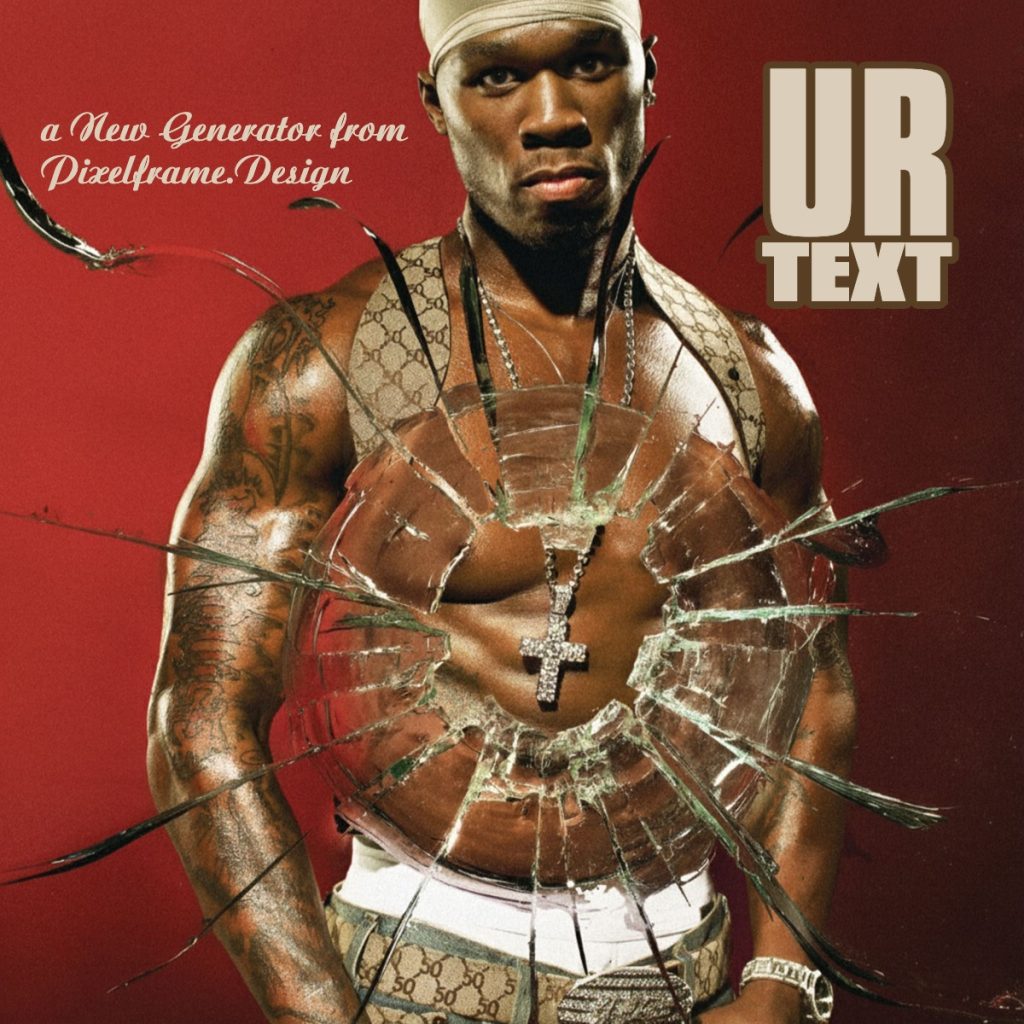
Album Cover Mode: Recreating Hip-Hop’s Most Iconic Debut
The standard album cover mode replicates the sophisticated visual design of Get Rich or Die Tryin’, which arrived on February 6, 2003, selling 872,000 copies in its first week and ultimately becoming the best-selling album of 2003 with over 12 million copies sold worldwide. The album’s cover art married street credibility with premium aesthetics through its strategic typography choices and dramatic photography of 50 Cent behind shattered bulletproof glass—a reference to the nine gunshot wounds he survived in May 2000.
The generator employs Ariston BQ Bold for the album’s script title text, a calligraphic typeface designed by Martin Wilke that evokes the ornate lettering found on currency and official documents. This choice reinforced the album’s central theme of wealth accumulation and survival against all odds. The font’s flowing, connected letterforms provided visual sophistication that balanced the raw street narratives in tracks like “Many Men (Wish Death)” and “Heat.”
For the “50 CENT” artist name, the original cover utilized Compacta, a condensed sans-serif typeface family created by designer Fred Lambert. The logo’s visual impact came from contrasting two weights within the Compacta family: Compacta Bold for the “50” numerals and Compacta Black for “CENT,” creating a hierarchy that drew the eye while maintaining cohesion. The bold, geometric letterforms projected strength and confidence, essential qualities for an artist emerging from the underground mixtape scene to challenge established New York rap hierarchy.
The cream and gold color palette—specifically the beige tones (#dccfba, #dbcebb) against brown strokes (#583e23)—created a luxurious visual language that distinguished Get Rich or Die Tryin’ from the chrome-and-diamond “bling era” aesthetics dominating hip-hop at the time. This restrained elegance suggested old money rather than new wealth, positioning 50 Cent as an heir to hip-hop royalty rather than a mere pretender.
PFP Version: The Power of the 50 Cent Logo
The profile picture mode isolates and emphasizes the “50 CENT” wordmark that became one of hip-hop’s most recognizable logos. This version centers the text against a black background with white typography and red accents (#e42336), then applies a grunge texture overlay for an distressed, street-worn aesthetic.
The Compacta typeface’s visual impact stems from its extreme condensation and geometric construction. Originally designed in the 1960s, Compacta features letterforms compressed to roughly 60% of standard width while maintaining full height, creating a towering, imposing presence. The sharp angles and minimal curves give the letters an architectural quality—they appear constructed rather than written.
What makes the “50 CENT” logo particularly effective is its exploitation of Compacta’s weight variations. The heavier weight used for “CENT” provides visual grounding, while the slightly lighter “50” creates movement and hierarchy. This contrast guides the viewer’s eye naturally from top to bottom, establishing clear readability even at small sizes—crucial for social media profile pictures where the logo often appears at 200×200 pixels or smaller.
The rounded strokes applied to the text outlines in this generator soften the otherwise angular letterforms slightly, preventing the harsh corners that can create visual tension at larger sizes. The colored background blocks behind each letter serve a dual purpose: they ensure legibility against varied backgrounds while creating depth through layering, giving the flat typography a sense of three-dimensionality.
The Album That Changed Hip-Hop
Get Rich or Die Tryin’ represented a seismic shift in hip-hop’s landscape. Following the September 11, 2001 attacks and amid changing cultural currents, the early 2000s saw rap evolving away from the smooth, radio-friendly sounds that had dominated the late 1990s. 50 Cent’s arrival—backed by Eminem’s Shady Records, Dr. Dre’s Aftermath Entertainment, and Interscope Records—brought gangsta rap roaring back to commercial dominance.
The album’s production showcased Dr. Dre (already experienced blending rap with widespread appeal with N.W.A) and Eminem as executive producers, with additional work from Mike Elizondo, Sha Money XL, and others. Tracks like “In da Club” became cultural phenomena, spending nine consecutive weeks atop the Billboard Hot 100. The song’s minimalist production—handclaps, organ stabs, and 50’s effortless flow—became the sonic template for mid-2000s hip-hop.
Released just one week early to combat rampant bootlegging and internet leakage, Get Rich or Die Tryin’ debuted at number one on the Billboard 200. By year’s end, it had generated four major singles: the chart-topping “In da Club” and “21 Questions” (featuring Nate Dogg), plus international hits “P.I.M.P.” and “If I Can’t.” The album received 9× Platinum certification from the RIAA by 2020 and earned rankings on numerous best-of-the-decade lists, including Rolling Stone’s 500 Greatest Albums of All Time at number 280.
New York Rap Context: Queens Meets Brooklyn and Beyond
50 Cent’s emergence occurred within a complex New York hip-hop ecosystem dominated by two towering figures: Nas and Jay-Z. Both Queensbridge native Nas and Brooklyn’s Jay-Z had established themselves as lyrical titans throughout the 1990s, with their legendary rivalry defining East Coast hip-hop discourse.
Before his shooting in 2000, 50 Cent had opened shows for Nas, who featured on two tracks from 50’s Guess Who’s Back? mixtape. This early connection to the Queensbridge legend provided credibility within New York’s rap community. However, 50’s provocative 1999 track “How to Rob”—which playfully threatened to stick up famous rappers—drew responses from Jay-Z, Big Pun, DMX, and others, establishing his combative reputation early.
By summer 2003, 50 Cent had grown powerful enough to co-headline the Roc the Mic Tour with Jay-Z, representing a complex dynamic where commercial interests temporarily superseded competitive tensions. That same year, 50 strategically released G-Unit’s Beg for Mercy the same day as Jay-Z’s The Black Album, directly challenging the Roc-A-Fella Records founder’s dominance.
The unrecorded version of “Back Down” from Get Rich or Die Tryin’ reportedly contained verses targeting Jay-Z, Nas, and Cam’ron, though these were removed from the final album. Producer Sha Money XL later confirmed that 50 Cent’s “marketing tool” involved creating controversy through name-dropping and nerve-pinching—a strategy perfected on “How to Rob” and refined throughout his career.
The Eminem Connection
50 Cent’s relationship with Eminem proved transformative for both artists. After surviving his 2000 shooting and being dropped by Columbia Records, 50 began releasing mixtapes that caught Eminem’s attention through 50’s attorney, who worked with Eminem’s manager Paul Rosenberg. Impressed by the Guess Who’s Back? mixtape, Eminem invited 50 to Los Angeles to meet Dr. Dre, resulting in a $1 million recording deal.
This connection culminated in 50 Cent’s prominent features on Eminem’s fourth studio album, Encore, released November 12, 2004. 50 appeared on three tracks: “Never Enough” (with Nate Dogg), “Spend Some Time” (with Obie Trice and Stat Quo), and the title track “Encore/Curtains Down” (with Dr. Dre). These collaborations showcased the mutual respect between the two artists, though some critics noted that 50’s verses occasionally outshone Eminem’s on tracks like “Never Enough.”
The Eminem partnership represented more than musical collaboration—it signified institutional backing from hip-hop’s most powerful figures. Shady Records and Aftermath Entertainment provided distribution muscle, production expertise, and marketing resources that transformed 50 from underground mixtape sensation to global superstar. Eminem’s own crossover success had proven white audiences would embrace authentic street narratives if presented with undeniable talent, paving the way for 50’s mainstream breakthrough.
A Career Defined by Conflict
50 Cent’s career has been marked by numerous high-profile feuds that extended well beyond typical rap rivalries. His ongoing conflict with Ja Rule and Murder Inc. dominated the early 2000s, while disputes with Fat Joe, Jadakiss, and others kept him in headlines throughout the decade. Even Oprah Winfrey found herself the subject of 50’s provocations after declining to have him on her talk show in 2003.
The most enduring and publicly documented feud has been with Sean “Diddy” Combs, spanning over two decades. The tension began in the early 2000s when 50 ghostwrote verses for Diddy, including parts of “Let’s Get It” and “I Get Money,” establishing a professional relationship that 50 later described as purely transactional: “I wouldn’t call it a friendship because there wouldn’t be disappointment between us if we didn’t speak to each other.”
In 2006, 50 released the diss track “The Bomb” (also known as “Hip Hop”), suggesting Diddy had knowledge of The Notorious B.I.G.’s 1997 murder. The accusations intensified in 2016 when 50 publicly agreed with theories from the documentary Murder Rap connecting Diddy to Tupac Shakur’s death. Throughout the 2010s and 2020s, 50’s Instagram became a primary platform for Diddy mockery, featuring AI-generated images, memes, and commentary on Diddy’s various controversies.
Sean Combs: The Reckoning
The decades-long tension reached its apex with 50 Cent’s role as executive producer of Sean Combs: The Reckoning, a four-part Netflix documentary series released in December 2025. The documentary examines Diddy’s career and the serious criminal allegations against him, including sex trafficking charges for which he was convicted in 2025.
50 defended his involvement in the project during a Good Morning America interview, framing it as cultural accountability rather than personal vendetta: “If I didn’t say anything, you would interpret it as hip-hop is fine with his behaviors. There’s no one else being vocal.” The documentary director, Alexandria Stapleton, drew inspiration partly from Cassie Ventura, Diddy’s former partner who testified against him in federal court.
The documentary’s release sparked fresh controversy, with Diddy’s son King Combs releasing a diss track titled “Pick a Side” defending his father and attacking 50 Cent. Actor Marlon Wayans also criticized 50’s involvement, using an AI-generated image of 50 and Diddy together to question 50’s motivations, prompting a characteristically sharp response from 50 on social media.
Critics and observers have debated whether 50’s documentary work represents legitimate cultural criticism or opportunistic score-settling. 50 has maintained that proceeds would benefit victims of sexual assault and rape, positioning the project as justice rather than entertainment. When asked if the documentary stemmed from their “beef,” 50 insisted his actions transcended personal conflict, focusing instead on exposing problematic behavior that the hip-hop community had allegedly ignored.
Typography as Brand Identity
The visual elements of Get Rich or Die Tryin’—particularly the Compacta-based “50 CENT” logo—established a brand identity that transcended music. This wordmark appeared consistently across album covers, merchandise, G-Unit clothing lines, and promotional materials throughout the 2000s, becoming as recognizable as the artist himself.
The typography choices reflected deeper marketing savvy. Where many rap logos embraced gothic or graffiti-inspired letterforms, 50’s Compacta wordmark suggested corporate professionalism and architectural permanence. The condensed sans-serif aesthetic aligned more with luxury fashion brands than street wear, positioning 50 as a businessman-rapper rather than merely an entertainer.
This visual strategy paralleled 50’s business expansion into vitamin water (his Glacéau investment reportedly earned him $100 million when Coca-Cola acquired the company), film and television production (the Power franchise became Starz’s highest-rated series), and various other ventures. The clean, bold typography communicated that 50 Cent was a brand to be taken seriously in boardrooms, not just recording studios.
Cultural Impact and Legacy
Twenty-two years after its release, Get Rich or Die Tryin’ remains a touchstone album that influenced a generation of artists. Its commercial success—selling over 872,000 copies in its first week and topping year-end charts—proved that hardcore street rap could achieve mainstream dominance without artistic compromise. The album restored gangsta rap to prominence during an era when industry observers had declared the subgenre commercially exhausted.
The album’s influence extended beyond sales figures. It demonstrated the power of mixtapes as artist development tools, with 50’s pre-album mixtape campaign creating unprecedented demand. This strategy became the blueprint for future rap stars, from Lil Wayne to Drake, who used free mixtapes to build audiences before major label releases.
Get Rich or Die Tryin’ also represented the apex of the “get rich or die trying” entrepreneurial ethos that would define 2000s hip-hop. Where 1990s rap often focused on artistic credibility or street authenticity as primary values, 50’s album championed commercial success as the ultimate vindication. This philosophical shift influenced countless artists and contributed to hip-hop’s transformation into American culture’s dominant musical and business force.
Using This Generator
The generator provides two distinct modes for creating custom graphics:
Album Cover Mode recreates the full Get Rich or Die Tryin’ aesthetic with the album’s signature background image, script title typography in Ariston BQ Bold, and the Compacta-based “50 CENT” wordmark. This mode preserves the original color palette and positioning, allowing users to input custom text while maintaining the album’s luxurious visual language.
PFP Version isolates the “50 CENT” logo against a black background with white text and red accents, adding a grunge texture overlay for a distressed aesthetic. This mode enlarges the typography and centers it for optimal visibility at profile picture dimensions, making it ideal for social media avatars or standalone logo usage.
Both modes employ advanced text-wrapping algorithms that intelligently break multi-word inputs across lines while maintaining visual balance between the “50” and “CENT” elements. The generator automatically calculates optimal font sizes to ensure both words maintain comparable widths, preserving the logo’s distinctive proportional relationships regardless of input text length.


