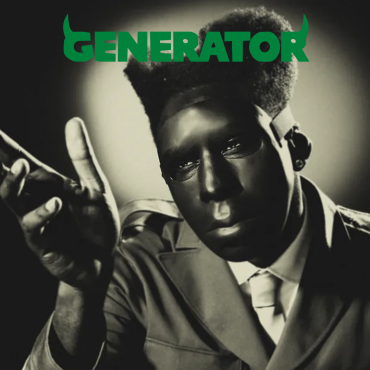
Create your own version of the Cherry Bomb album cover with our custom font generator
The Cherry Bomb font generator has been updated with improved styling and added features! You can now toggle an alternate plain white background version, insert the pink face icon, and download the text only as a transparent .PNG file.
Tyler, The Creator’s Cherry Bomb marked a significant evolution in Tyler’s musical style, moving away from his earlier horrorcore roots toward a more experimental and melodic sound.
This generator recreates the art and font style of the original Cherry Bomb album cover, and allows you to type your own custom text (then drag individual characters around the canvas to get the perfect alignment). An original custom hand-drawn 3D block-style font has been created, featuring a full set of capital letters, numbers, and basic punctuation.
For exclusive early access to new album generators, please join our mailing list. No spam or ads, just simple email alerts when new generators are created.
How to use the Cherry Bomb Font Generator
- Type your text in the box below the cover image
- The full set of letters are supported, as well as numbers and basic punctuation
- Use your cursor to drag individual letters around the canvas
- For enhanced customizability you can adjust the exact positioning of each character, use this feature to mimic the arched text of the original, or position your text on either side of the background image to use the head as an ‘O’ like on the album cover
- If needed, re-type text in the box and re-generate until you’re finished
- Download Your Artwork
- Once generated, click the “Download Cover” button to save your custom artwork
- The image will download as a high-quality PNG file
Tyler, The Creator’s “Cherry Bomb” Album Cover: Explosive Minimalism and Bold Typography
The album cover for Tyler, The Creator’s 2015 project “Cherry Bomb” is a masterclass in aggressive simplicity and rebellious design. Dominated by bold, all-caps pink typography that screams the album title against a stark background, the cover perfectly captures the abrasive, experimental sonic chaos contained within. This was Tyler at his most uncompromising—both musically and visually—creating an aesthetic statement that refused to play by conventional rules.
Typography as Sonic Visualization
The oversized, distorted lettering on “Cherry Bomb” doesn’t just spell out the album title; it visualizes the music itself. The font appears deliberately crude, almost blown-out, as if the letters themselves are exploding off the cover. This typographic violence mirrors the album’s harsh production, where Tyler intentionally pushed levels into the red, creating a wall of sound that divided critics and fans alike. The design philosophy here is pure punk rock attitude filtered through hip-hop sensibility—beauty through deliberate imperfection.
This bold use of typography as the primary visual element has influenced how artists approach album artwork in the streaming era. The cover works just as effectively as a tiny thumbnail as it does at full size, a crucial consideration for digital consumption. Artists like Brent Faiyaz and Roddy Ricch have since embraced similarly bold textual elements in their visual branding, understanding that clear, striking design cuts through the noise of endless content.
The Golf Wang Aesthetic Evolution
“Cherry Bomb” represents a critical moment in the evolution of Golf Wang, Tyler’s fashion brand and creative universe. The bright pink and aggressive design language seen on the cover became integral to Golf Wang’s identity—playful yet confrontational, colorful yet abrasive. This fusion of streetwear culture with fine art sensibilities helped establish Tyler as a complete creative visionary rather than just a rapper.
The cover’s aesthetic sits in conversation with the broader landscape of hip-hop visual innovation. While contemporaries like Kendrick Lamar often favored complex, narrative-driven imagery and Kanye West pushed minimalism to its conceptual limits, Tyler carved out space for something more visceral and immediate. The “Cherry Bomb” cover doesn’t tell a story or present a carefully composed photograph—it simply explodes with raw energy and demands attention.
Color Theory and Emotional Intensity
The shocking pink hue dominates the cover, a color choice that subverts hip-hop’s traditional masculine visual codes. Pink—often feminized in Western culture—becomes aggressive and confrontational in Tyler’s hands. This willingness to challenge gender norms through visual presentation has influenced a generation of artists exploring identity and expression beyond traditional boundaries. The color choice also ensured the album stood out in record stores and on streaming platforms, impossible to ignore or scroll past.
This bold approach to color as emotional communication connects Tyler’s work to a lineage of artists unafraid to make controversial visual statements. From 2Pac‘s iconic, politically charged imagery to the dark, moody aesthetics embraced by artists like The Weeknd and Travis Scott, hip-hop has always understood that album covers are more than decoration—they’re manifestos.
Collaborative Energy and Creative Community
Though Tyler’s face doesn’t appear on the “Cherry Bomb” cover, his creative fingerprints are unmistakable. The album featured collaborations with his Odd Future affiliates including Earl Sweatshirt, and the cover’s DIY aesthetic reflects the collective’s broader ethos of creative independence and refusal to compromise artistic vision for commercial palatability. This spirit of artistic autonomy would later influence how Tyler approached his subsequent, more acclaimed albums, where visual sophistication evolved while maintaining that core rebellious energy.
The cover also represents a bridge between Tyler’s early, more chaotic work and his later artistic refinement. Artists like 21 Savage have similarly navigated the balance between maintaining street credibility while evolving artistically, using album covers to signal both growth and authenticity to their audiences.
Legacy and Influence
While “Cherry Bomb” may not be Tyler’s most critically acclaimed album, its cover remains one of his most recognizable and influential visual statements. The design’s raw energy and typographic boldness proved that album artwork could be confrontational, even ugly by conventional standards, and still be effective—perhaps even more so. In an era of increasingly polished, focus-grouped visual content, “Cherry Bomb” stands as a reminder that sometimes the most memorable art comes from refusing to polish away the rough edges.
The cover’s legacy extends beyond hip-hop, influencing graphic design, streetwear, and visual culture broadly. It demonstrated that artists with strong creative vision could use their album covers as extensions of their broader aesthetic universe, blurring lines between music, fashion, and visual art. This holistic approach to artistic identity has become standard practice for ambitious artists across genres, but “Cherry Bomb” remains a landmark example of uncompromising creative vision executed with explosive clarity.