
Enter your text in the box below the image and click “Generate Cover”.
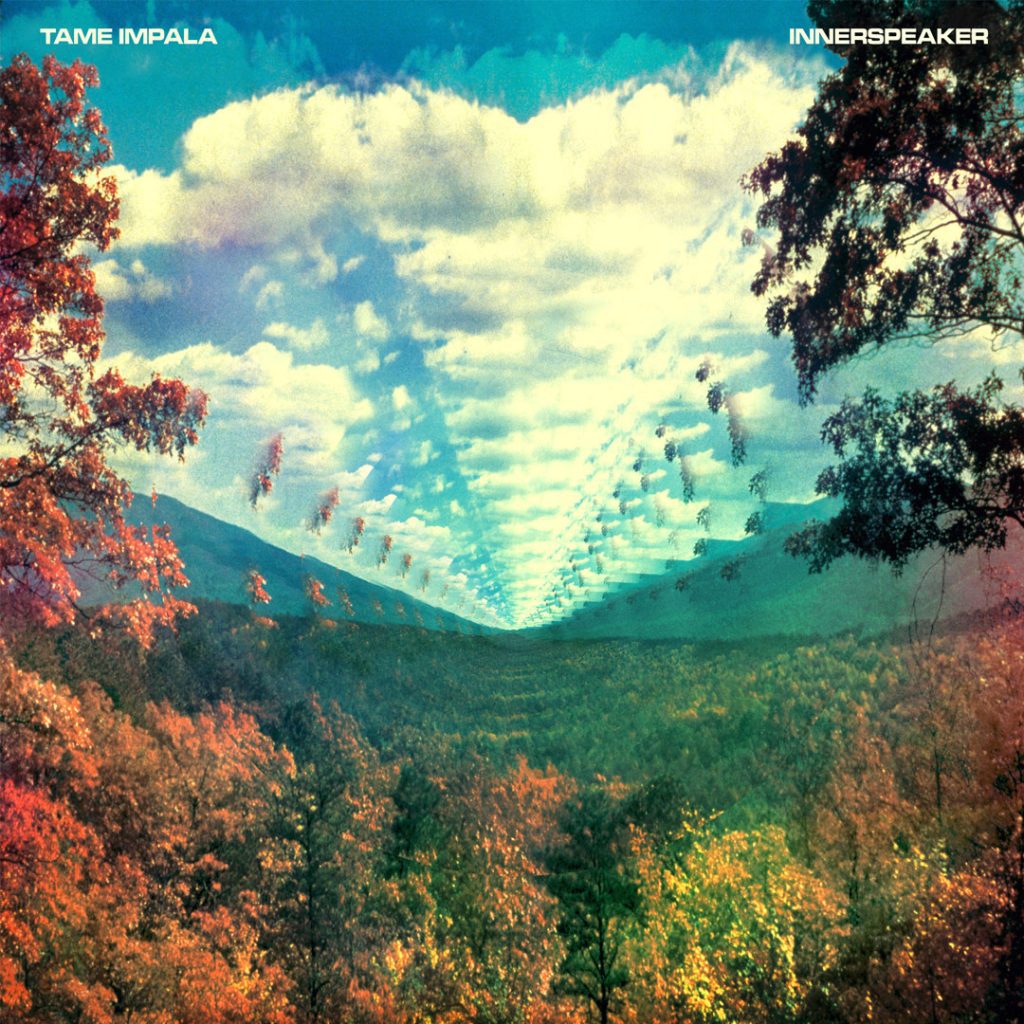
The Innerspeaker Text Generator pays homage to Tame Impala’s groundbreaking 2010 debut album. The original cover art, designed by Leif Podhajsky, became instantly iconic for its kaleidoscopic treatment of a forest landscape, where prismatic reflections create an infinite visual loop. This hypnotic design perfectly complemented the album’s psychedelic rock soundscape, helping establish the visual aesthetic that would become synonymous with Tame Impala’s early era. Create your own version with this generator, and you can get the font Microgramma, used on the original cover art here.
Remember to tag us on social media with your creations: X Facebook Instagram and TikTok
As always, if there’s specific album generator you’d like to see, please let us know.
sample text
For exclusive early access to new album generators, please join our free mailing list. No spam or ads, just simple email alerts when new generators are created.
Tame Impala’s “Innerspeaker” Album Cover: Psychedelic Photography and Organic Abstraction
The album cover for Tame Impala’s 2010 debut “Innerspeaker” is a mesmerizing piece of psychedelic photography that perfectly encapsulates the Australian project’s swirling, kaleidoscopic sound. Created by artist Leif Podhajsky, the cover features an abstract, organic image that appears to show natural elements—possibly flowers, plants, or cellular structures—rendered in dreamy, saturated colors that bleed and blur into one another. The result is simultaneously inviting and disorienting, much like the music itself.
Organic Psychedelia and Visual Texture
The “Innerspeaker” cover embraces a distinctly analog, organic aesthetic that feels worlds away from digital precision. The image’s soft focus and bleeding colors create a dreamlike quality that suggests the album was designed to be experienced rather than merely heard. The warm color palette—dominated by oranges, pinks, and earth tones—evokes both sunset landscapes and interior consciousness, perfectly matching the album’s title and its exploration of inner mental spaces.
This naturalistic approach to psychedelic imagery connects Tame Impala’s visual language to a rich tradition of rock bands using abstract, mood-driven artwork. Radiohead‘s “In Rainbows” similarly employed abstract visual elements and soft, blurred imagery to create atmospheric expectations, though where Radiohead leaned into cooler, more melancholic tones, Tame Impala embraced warmth and organic texture. Both covers understand that psychedelic music benefits from artwork that doesn’t literalize the experience but rather creates a visual analogue to the sonic journey.
The Leif Podhajsky Aesthetic
Leif Podhajsky’s distinctive photographic manipulation style became inseparable from Tame Impala’s early visual identity. His approach—taking natural imagery and processing it into something surreal yet recognizable—created a signature look that fans immediately associated with Kevin Parker’s music. The slightly vintage quality of the processing, combined with the organic subject matter, gives “Innerspeaker” a timeless feel that doesn’t date itself to any particular era of design trends.
This commitment to a cohesive visual identity through collaboration with a specific visual artist mirrors how bands like Arctic Monkeys have worked with designers to create distinct visual worlds for their albums, or how The Cure maintained atmospheric consistency across their extensive catalog through careful attention to mood and tone in their artwork.
Psychedelic Revival and Contemporary Context
“Innerspeaker” arrived during a revival of psychedelic rock aesthetics in the late 2000s and early 2010s, but its visual presentation avoided cliché tie-dye patterns or retro pastiche. Instead, Podhajsky’s modern approach to psychedelic imagery felt fresh and contemporary while honoring the genre’s history. The cover suggested that psychedelia could be subtle, sophisticated, and deeply personal rather than bombastic or purely nostalgic.
Bands like The Black Keys were similarly mining vintage rock sounds during this period, though their visual presentations often leaned more heavily into retro americana and blues-rock aesthetics. Franz Ferdinand had explored angular, art-rock visuals earlier in the decade. Tame Impala’s approach carved out distinct territory—neither purely retro nor aggressively modern, but existing in a dreamy space between past and present.
The Evolution of Tame Impala’s Visual Identity
Understanding “Innerspeaker” requires seeing it as the beginning of Tame Impala’s visual journey. “Lonerism” (2012) continued working with Podhajsky, featuring similarly abstract, colorful imagery that deepened the psychedelic aesthetic while exploring themes of isolation and social anxiety through its visuals. The cover’s concentric circular patterns and saturated colors created a sense of being pulled inward, matching the album’s introspective themes.
“Currents” (2015) marked a dramatic shift—both sonically and visually—with its striking split-face profile and bold graphic design. The move toward more structured, graphic imagery paralleled the music’s evolution toward more electronic, pop-influenced sounds. This willingness to evolve visually while maintaining core aesthetic values demonstrates artistic confidence and growth.
“The Slow Rush” (2020) returned to more abstract, atmospheric imagery with its desert landscape dissolving into waves and particles, suggesting the passage of time and shifting perceptions. Each album’s cover charts Kevin Parker’s artistic evolution while maintaining visual coherence across the discography.
Photography as Portal
What makes “Innerspeaker” particularly effective is how the photographic manipulation creates a sense of looking through something rather than at something. The image feels like a portal or window into another consciousness—an appropriate visual metaphor for an album titled “Innerspeaker.” The slightly out-of-focus quality invites viewers to lose themselves in the details, discovering new textures and patterns with each viewing.
This approach to photography as experiential rather than documentary connects to broader movements in album artwork where the goal isn’t to capture a moment but to create an atmosphere. The cover doesn’t tell you what the album sounds like; it makes you feel what the album sounds like.
Texture, Grain, and Analog Warmth
The visible grain and texture in “Innerspeaker’s” artwork communicates analog warmth in an increasingly digital age. This textural richness suggests music recorded with attention to sonic detail and organic interplay between instruments—which accurately describes Tame Impala’s meticulously crafted production despite being largely a one-man project. The artwork’s lo-fi aesthetic qualities belie the sophisticated production techniques Parker employed in creating the music.
Cultural Impact and Lasting Influence
“Innerspeaker” helped establish a visual template for modern psychedelic rock that countless bands have since referenced or built upon. Leif Podhajsky’s style became so associated with contemporary psych-rock that his aesthetic influence can be traced through indie and alternative rock artwork throughout the 2010s. The cover proved that psychedelic imagery could be sophisticated, subtle, and commercially successful—opening doors for more experimental visual approaches in mainstream alternative music.
The album’s visual identity contributed to Tame Impala’s rise from cult Australian act to globally recognized festival headliner. Strong, distinctive artwork helped the music cut through noise and established Kevin Parker as a complete artistic visionary rather than just a talented musician. “Innerspeaker” announced that Tame Impala would be creating complete worlds—sonic and visual—that fans could inhabit and explore.
Looking back, “Innerspeaker’s” cover remains a landmark in contemporary rock album design—a perfect marriage of image and sound that captures a specific artistic vision while remaining open to interpretation. Its organic psychedelia continues to influence how artists approach visual presentation for music that explores inner consciousness, natural beauty, and the spaces where reality becomes beautifully uncertain.


